Under the Skin of the Earth
Updated: May 18
My Journey in Paleontology
Since 2014, a significant part of my artistic and pedagogical identity has been shaped not only in rehearsal rooms and classrooms, but also in the quiet layers of Miocene sediment. For more than a decade, I have volunteered at the Vasile Pârvan Museum (Natural Sciences Department) under the guidance of PhD Engineer Laurențiu Ursachi, contributing to paleontological research, fieldwork, conservation, and scientific communication.
Although my professional path is rooted in theatre and education, paleontology has become a parallel discipline—one that continuously enriches my teaching philosophy, my sense of narrative, and my understanding of time, structure, and transformation.
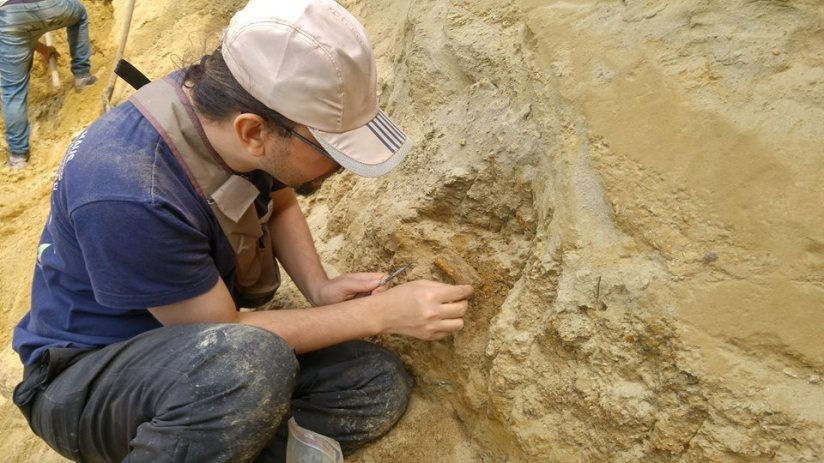
Field Research and Fossil Discoveries
My collaboration began with hands‑on fieldwork:
• participating in in situ excavations as part of Dr. Ursachi’s research team,
• personally discovering several Miocene fossils during these campaigns,
• assisting in the photographic documentation of both bone material and lithological samples, including the Deinotherium specimen from Gherghești.
These experiences taught me to read landscapes the way an actor reads a script—attentively, patiently, and with respect for what lies beneath the surface.

Conservation, Restoration, and Scientific Documentation
Back in the laboratory, I contributed to:
• conservation and restoration of fossil material, including work on Testudo lohanica, a species newly described for science,
• writing heritage inventory sheets,
• selecting and translating scientific articles for Dr. Ursachi’s research archive (from Chinese, English, French, and Italian),
• creating the documentary film that presents the research and restoration process of Testudo lohanica for the museum.

Scientific Events and Public Engagement
I have also supported the museum’s scientific outreach by:
• assisting in the organization of conferences, including the 2017 lecture by PhD Jay Kelly (USA),
• contributing to public communication and educational materials,
• helping expand the museum’s research visibility.
Through my involvement in paleontological research, I’ve come to see even more clearly that science and art pursue the same purpose—bringing knowledge into a form that is accessible, meaningful, and... alive.

Building a Paleontology Association: DEINOTERRA
When our research team decided to establish a dedicated paleontology association, I became actively involved in its creation and development. I was elected Executive Vice President of the DEINOTERRA Association, contributing to:
• choosing the association’s name and visual identity,
• drafting the statute and organizing the founding meeting,
• obtaining the association’s legal status (2018),
• creating the official website,
• producing documentary materials (video and photography) in natural science museums across Beijing(China), Brussels(Belgium), London(UK), Venice and Asti(Italy), and Bucharest(Romania),
• managing the association’s public presence through social media,
• securing a photo mini‑studio through sponsorship,
• supporting fundraising efforts,
• assisting in the writing of the association’s scientific programs,
• personally sponsoring fieldwork logistics, including transportation for Dr. Ursachi,
• handling the association’s official correspondence.

Why Paleontology Matters in My Work as a Drama Teacher
Paleontology has taught me to approach artistic training with a deeper sense of time, patience, and observation. Excavation is, in many ways, a dramaturgical act:
• uncovering hidden structures,
• reconstructing narratives from fragments,
• understanding transformation across eras,
• and cultivating a disciplined curiosity.

My work in paleontology is not a separate chapter of my life—it is a companion discipline that continually informs my artistic practice, my teaching, and my understanding of human knowledge across time.


Comments